


Analytical Capabilities
Equipment and Facilities at FIERCE
At FIERCE, we operate state-of-the-art facilities for elemental and isotopic analyses, namely single-collector (ICPMS) and multi-collector inductively-coupled plasma mass spectrometers (MC-ICPMS). These (MC-)ICPMS are used in conjunction with both solution and laser-ablation sample introduction systems (see below).
Our broad range of expertise in isotope and (trace) elemental analyses and applications include radiogenic and stable isotope tracers in environmental, geological, biological and archaeological studies as well as U-(Th)-Pb or Rb/Sr geochronology.
More specifically, we specialize in trace elements and Li, B, Sr, Nd, Pb, and Hf isotopes as tracers in a wide range of applications. This allows us to elucidate processes in low-temperature geochemistry such as (palaeo)environment, palaeoclimatology, hydrosphere or sedimentary provenance, as well as those in high-temperature geochemistry, such as mantle geochemistry or crustal evolution.
ICPMS instruments
- Neptune Plus: High-sensitivity MC-ICPMS with multiple ion counting (2 SEM, 5 CDD) and nine Faraday cups (1011 and 1013 Ω amplifiers) for highest-precision (~0.02 ‰) isotope ratio analysis of typically single elements: installed in 2018
- Element XR: Single-collector sector-field ICPMS for rapid multi-element analysis across 9 orders of magnitude in concentrations and/or low-precision (few ‰) isotope ratio analysis: installed in 2018
- Element 2: overall same as above, installed in 2000
- Agilent 8900: ICP-MS/MS system using collision/reaction cell gases (H2, He, O2, SF6, N2O, NH3) to remove/control spectral interferences (‘triple-quadrupole or tandem mass spectrometry’). This capability is used, for example, for laser ablation Rb/Sr and Lu/Hf isotope measurements as well as trace element determinations; installed in 2024.
Sample introduction systems
Each of our three ICPMS instruments can be coupled, depending on the application, to:
- Our 193 nm RESOlution-LR laser ablation system with a Laurin Technic S155 two-volume LA cell for spatially-resolved elemental or isotope-ratio analysis, or
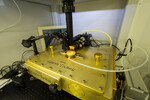
- Our novel custom-designed dual-wavelength (193 nm & 157 nm) laser ablation system built around a RESOlution-SE laser ablation system, also featuring a Laurin Technic S155 two-volume LA cell that can be equipped with a novel cryo-sample holder for the analysis of frozen samples such as ice cores. The 193 nm beam path features a high-repetition rate laser enabling quick elemental and isotopic mapping using a fast-washout setup, whereas the unique 157 nm beam path enables controlled abalation of frozen ice. Operational since 2025 (see Erhardt et al., JAAS 2025).
- Furthermore one of three desolvating nebulisers and different glass spray chambers for elemental or isotope ratio analysis of liquid samples.
Clean laboratory facilities
Sample preparation including sample dissolution and ion exchange chemistry at very low-blank levels (pg-range) takes place in a dedicated suite of PicoTrace clean labs with micro balances, fume hoods for acid digestion using various types of acids (e.g., HF, HNO3, HCl). The clean labs are vented by a hepa-filter air-handling system and provide high-purity water and acids to guarantee low analytical blanks across the periodic system (e.g., Li, B, Pb, etc.).
Mineral separation, micro-sampling and imaging
A well-equipped sample fragmentation and preparation facility is available for the extraction of heavy mineral concentrates using density and magnetic methods. This includes a SelFrag electric fragmentation device. We have access to microanalytical facilities for imaging and characterisation of samples using a JEOL scanning electron microscope, equipped with CL detector and EDX analyser and a JEOL JXA-8530F-Plus Hyperprobe field-emission gun electron probe microanalyzer.